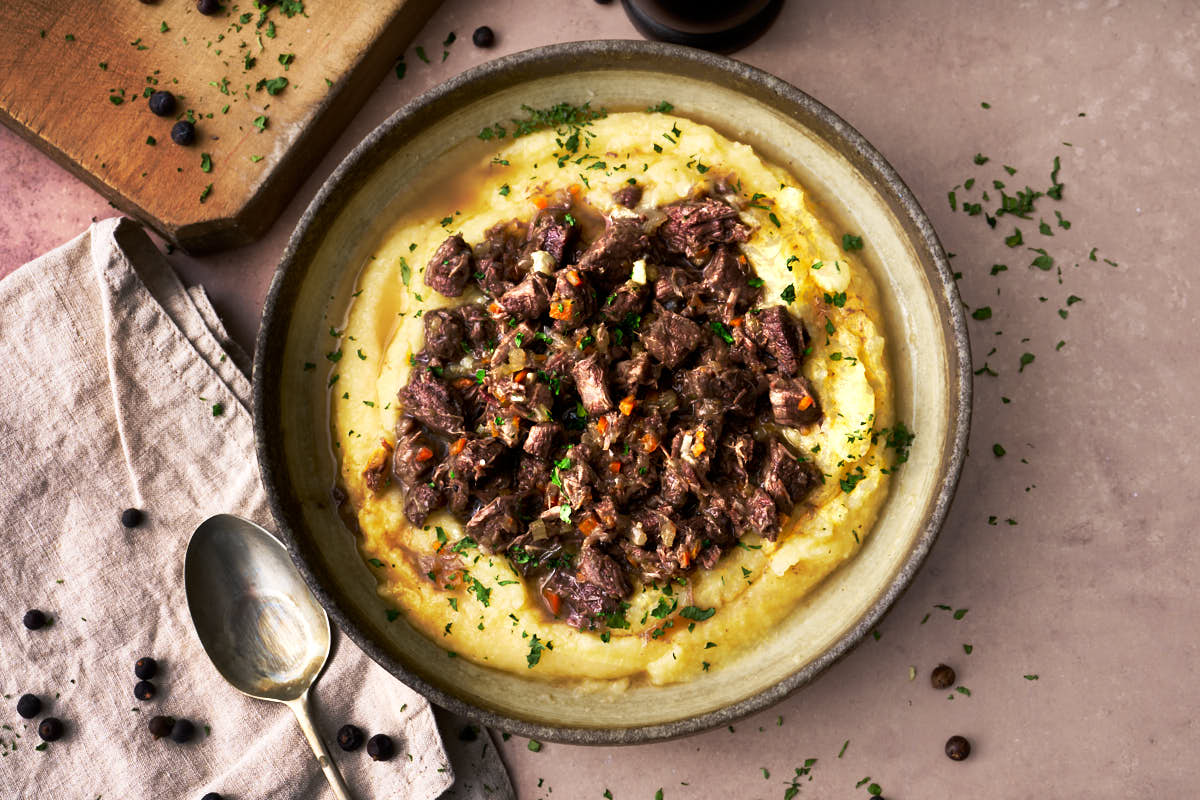
Tuscan wild boar ragu is so iconic that it would be easy to assume that this is the only way Italians cook wild boar. But to think that would be to miss out on some extraordinary regional variations like this recipe for Friulian wild boar in umido with polenta.
What is cinghiale in umido alla friulana?
Cinghiale in umido means “braised wild boar” – umido literally translates as “wet” or “moist”, which is the Italian way of describing slow-cooked meat in sauce.
What makes this Friulian dish different from every other wild boar recipe in Italy is the marinade. It’s called the beize(BAY-zeh), and it changes everything.
What is the beize?
What makes this Friulian version different is the beize. It’s a marinade of white wine, vinegar and spices, boiled first then cooled and poured over the meat to soak overnight.
You’d expect vinegar to make something sharp. It doesn’t. The flavour it produces is subtler than that – softer, a little sweeter, and quite different from anything a red wine marinade gives you. Served on polenta rather than pasta, this is true Friulian cooking.
Austrian Influences
Friuli sits in Italy’s northeastern corner. To the north and east, the borders of Austria and Slovenia are just a few kilometres away. For most of its history, Friuli was not Italian at all – it was part of the Habsburg Empire, ruled from Vienna. That history shaped the cooking in ways that are still obvious today.
In fact ‘beize’, the cooked vinegar soaking liquid, is borrowed from the German word for marinade. And you’ll find versions of the beize technique in Austrian and South Tyrolean game cookery on the other side of the border. In Friuli it crossed over, took root, and never left.
This is not Tuscan wild boar. This is something different and more interesting.
Where to Buy Wild Boar
Wild boar is increasingly available in the UK and US through specialist game butchers and online suppliers. Frozen is fine – it actually helps to break down the muscle fibres before a long braise. Shoulder or leg are the right cuts: you want pieces with enough connective tissue to melt down into the sauce during cooking.
Always buy from a reputable supplier and check that the meat has been inspected for trichinella, which is standard for any commercially sold game. Farmed wild boar is also available and works perfectly in this recipe – it’s slightly milder than truly wild meat, which is no bad thing for home cooking.
More About Cinghiale
Wild boar is the defining ingredient of Tuscan autumn cooking. Find out what cinghiale is, where it lives, and how Tuscans cook it.
Read the Cinghiale GuideThe wine: Refosco dal Peduncolo Rosso
The traditional wine pairing for cinghiale in Friuli is Refosco dal Peduncolo Rosso – the great indigenous red grape of the region. It’s tannic, earthy, and slightly bitter, with dark fruit and a dry, structured finish. Those qualities make it a natural match for game.
Use a glass of Refosco in the braise itself, then serve the rest of the bottle with dinner. If you can’t find Refosco, a Schioppettino (also known as Ribolla Nera) is the next best Friulian option. Outside the region, a northern Rhône Syrah or a Barbera d’Asti will work well.
The Polenta
In Friuli, cinghiale comes with polenta. Not pasta. Not bread. Polenta has been the staple grain of the region for centuries, and the combination of a rich game braise with soft, buttery polenta is one of those perfect pairings that needs no justification.
For this recipe I use a medium-coarse polenta – not instant – cooked slowly and finished with butter and a little Montasio cheese if you can find it, or Parmigiano Reggiano as a straightforward substitute. The polenta should be soft enough to pour loosely onto the plate, not stiff enough to slice.
How to make cinghiale in umido alla friulana
This is a two-day recipe. Day one is marinading the wild boar in the beize marinade. Day two is slow-cooking the meat in the oven on a low heat. Neither day involves much active cooking time – most of it is the fridge or the oven doing the work.
Why doesn’t this recipe use tomato?
Almost every Italian wild boar recipe uses tomato. This one doesn’t, and that’s part of what makes Friuli wild boar in umido unusual.
Tomato tends to add acid to the dish. The Friulian in umido tradition is a white braise – and the acid comes from the vinegar and white wine. The result is more subtle than a tomato-based sauce.
If you’ve only ever made the Tuscan version of this dish, this is going to taste quite different. That’s the point.
Tips for home cooks
The overnight wait is not optional. The beize doesn’t just flavour the surface – it penetrates the meat and starts to break down the tougher muscle fibres. This is an important part of the process and a big part of making this dish taste great.
Brown the meat properly. This is where most home cooks go wrong with braises. Each piece of boar needs real, deep colour on all sides before it goes into the sauce. That browning is flavour. Be patient and do it in batches.
Don’t rush the polenta. Instant polenta exists and it’s fine in an emergency, but it doesn’t taste the same. Medium-coarse polenta cooked slowly for 40 minutes is a different product. It’s worth the extra time.
Leftovers are better. Like all braises, this reheats beautifully. The sauce deepens overnight in the fridge. Make it the day before dinner if you can.
Can I make this with a different meat?
Yes. If you can’t source wild boar, pork shoulder is the closest substitute – it has a similar fat distribution and will respond well to both the beize and the long braise. The flavour will be milder and less complex, but the technique still works. Venison shoulder is also excellent with the beize and gives you back some of that gamey depth if wild boar genuinely isn’t available.
Buon appetito! 🇮🇹
More Wild Boar Recipes
Wild boar is worth getting to know across the regions. Here’s how the rest of Italy does it.
Tuscan Wild Boar Ragù – a classic wild boar ragu from Florence
Wild Boar Ragu – another Tuscan variation.
More Friuli Recipes
- Friuli White Asparagus with Egg Sauce – white asparagus dressed with a warm egg sauce. A Friuli spring tradition.
- Jota – the thick winter soup of beans, sauerkraut and smoked pork that defines Friuli cooking.
- Karst Venison with Juniper – venison slow-cooked with juniper berries and mountain herbs from the Karst plateau.
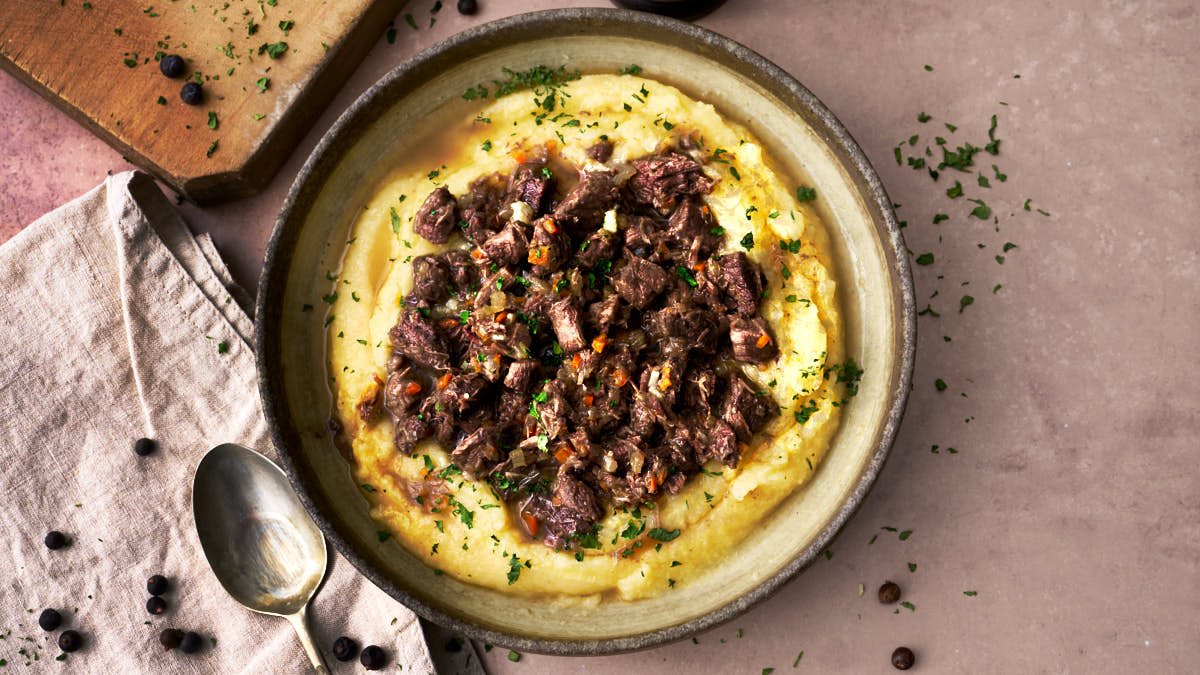
Friuli Wild Boar with Polenta (Cinghiale in Umido alla Friulana)
Equipment
- Cast Iron Pan
- Chef Knife
- Chopping Board
- Wooden Spoon
Ingredients
Ingredients – the beize:
- Ingredients – the beize:
- 250 ml white wine vinegar
- 250 ml red wine (Refosco or similar)
- 1 medium onion (roughly sliced)
- 1 carrot (roughly chopped)
- 1 stick celery (roughly chopped)
- Small bunch fresh parsley
- 2 bay leaves
- 4 cloves
- 1 tsp black peppercorns
- 6 juniper berries (lightly crushed)
- Ingredients – the braise:
- 1.2 kg wild boar shoulder or leg (cut into large chunks (approx. 6-7cm))
- 2 tbsp olive oil
- 30 g butter
- 1 medium onion (finely chopped)
- 1 carrot (finely chopped)
- 1 stick celery (finely chopped)
- 200 ml red wine (Refosco)
- 300 ml chicken or game stock
- Salt and black pepper
- Fresh parsley to finish
Instructions
Day 1 – Make the Marinade (Beize)
- Combine all the beize ingredients in a medium saucepan. Bring to the boil, stir, and simmer for 5 minutes. Remove from the heat and allow to cool completely – this will take 1-2 hours, or speed it up in a cold water bath.
- Place the wild boar pieces in a non-reactive bowl or container (ceramic, glass, or plastic). Pour the cooled beize over the meat – it should cover or nearly cover the pieces. Cover and refrigerate for 12-24 hours. 12 hours is fine. 24 hours gives a deeper result.
DAY 2 – STEW
- Remove the boar from the beize and pat each piece dry with kitchen paper. Don’t skip this step – dry meat browns much better than wet meat. Strain and reserve the beize liquid, discarding the vegetables and spices.
- Preheat your oven to 160°C / 140°C fan / gas mark 3.
- Heat the olive oil and butter in a large heavy casserole dish over a medium-high heat. Brown the boar pieces in batches, 3-4 minutes per side, until deep brown on all surfaces. Don’t crowd the pan. Move each batch to a plate as it browns.
- Turn the heat down to medium. Add the onion, carrot, and celery to the same pan and cook for 8-10 minutes, stirring occasionally, until soft and golden.
- Return the browned boar to the casserole. Pour in the red wine and let it bubble for 2 minutes. Add 100ml of the strained beize liquid and the stock. The liquid should come about halfway up the meat – top up with stock if needed. Season with salt and pepper.
- Bring to a gentle simmer, then cover and transfer to the oven. Cook for 2.5 to 3 hours, until the meat is completely tender and pulls apart easily with a fork.
- Remove the meat with a slotted spoon. If the sauce is thin, reduce it on the hob over a medium heat for 5-10 minutes until it coats the back of a spoon. Taste and adjust seasoning. Return the meat to the sauce.
- To serve spoon soft polenta into wide bowls. Lay the braised boar on top and spoon over the dark sauce generously. Scatter fresh parsley on top.