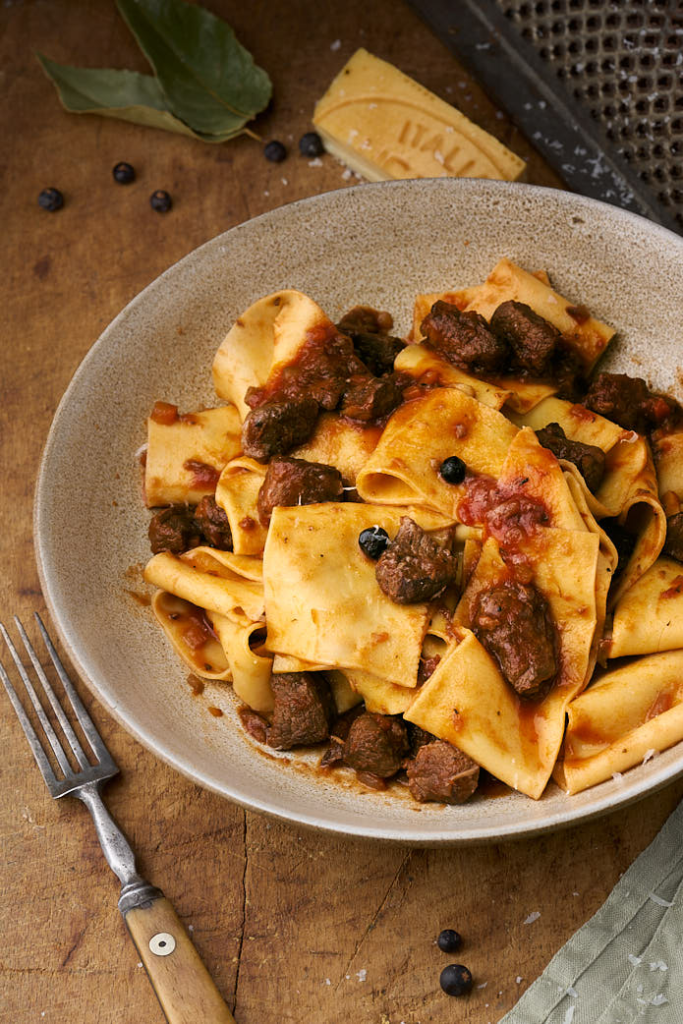
I ate this Tuscan Wild Boar Ragù dish at a restaurant in Florence. It was so good – the sauce darker and richer than anything I’d ever made at home. And I kicked myself for not asking how it was made. Undeterred, I emailed the restaurant and asked if they could share the recipe. I received a very kind reply from the restaurant owner, along with four simple recipe steps. No ingredient weights. No times. No clever tricks. What struck me was how simple the base recipe actually is.
Just good wild boar, a bottle of Tuscan red, and time. That’s pretty much it. This Tuscan wild boar ragù – ragù di cinghiale (rah-GOO dee chin-YAH-leh), meaning wild boar sauce – is one of those dishes that proves Italian cooking at its best is about restraint, not complexity. The restaurant’s recipe is below. The only thing I’ve added is weights and timings.
What is Tuscan wild boar ragù?
Ragù di cinghiale is a slow-cooked meat sauce from Tuscany. It’s a pasta sauce — a primo (first course) — traditionally served over wide, flat pasta ribbons called pappardelle. Wild boar gives the sauce a deeper, earthier flavour than beef or pork ragù. It’s richer. More structured. The red wine marinade is what makes this dish distinctly Tuscan rather than just a generic meat sauce. You’ll find it on almost every trattoria menu in the region from October through to February.
Tuscany Wild Boar Tradition

Wild boar has roamed the forests of Tuscany for centuries. The Maremma — the wild coastal strip in southern Tuscany — has always had a particularly large boar population, and hunting has been part of life there since Roman times.
The dish as we know it today almost certainly developed as peasant cooking. Nothing from a boar hunt went to waste. The tougher cuts — shoulder, leg — needed long, slow cooking in wine to become tender. That practical necessity is what shaped the recipe. The marinade wasn’t a fancy technique. It was a way of softening a tough, gamey animal before the days of refrigeration.
By the medieval period, wild boar was also prized by the Tuscan nobility. The same animal fed both the peasant and the lord, cooked in remarkably similar ways.
Today the tradition holds. Farmed wild boar is now widely available, which makes the recipe more accessible. But the flavour profile — wine, juniper, slow heat — hasn’t changed. Every mouthful still tastes like the Tuscan countryside in winter.
More About Cinghiale
Wild boar is the defining ingredient of Tuscan autumn cooking. Find out what cinghiale is, where it lives, and how Tuscans cook it.
Read the Cinghiale GuideWhat you need — key ingredients
Wild boar shoulder is the cut to use here. It has enough fat and connective tissue to break down over a long cook. Leg works too. Avoid loin — it’s too lean and will dry out. In the UK, you can find wild boar at good butchers or online from specialist game suppliers. [AFFILIATE: online wild boar supplier] Farmed wild boar is milder than truly wild boar, but still far more interesting than pork.
Red wine does two jobs. First it marinates the meat overnight, drawing out the strongest gamey notes. Then a fresh glass goes into the sauce itself. Use a Tuscan red if you can — a Rosso di Montalcino or a decent Chianti. Don’t cook with wine you wouldn’t drink. That rule matters more here than in most recipes.
Juniper berries are the flavour that makes this dish unmistakably Tuscan. Crush them lightly before adding — just enough to crack them open. They add a faint piney, almost resinous note that cuts through the richness of the sauce. You’ll find them in most supermarkets in the spice aisle.
Passata — sieved tomatoes — gives the sauce its body. Don’t use chopped tomatoes. The texture will be wrong and the sauce won’t coat the pasta properly.
Soffritto — the base of diced carrot, celery, and onion — builds the foundation of the sauce. Don’t rush this step.
How to make Tuscan wild boar ragù — tips and technique
The marinade is not optional. Twenty-four hours in red wine with the vegetables and juniper does real work. It softens the meat and takes the edge off the gamey flavour. Shorter than that and you’ll notice the difference. If you’re using farmed boar rather than truly wild, twelve hours is probably enough.
When you drain the meat, discard the marinade vegetables. They’ve done their job. Don’t be tempted to add them to the sauce — they’ve absorbed too much of the gamey liquid and will make the final dish taste muddy.
Brown the boar in batches. This is the step most people rush, and it matters. You want real colour on the meat — deep brown, not grey. That browning is flavour. Use a heavy-bottomed pan, get it properly hot, and don’t crowd it.
The sauce needs a genuine low simmer for two to three hours. A bubble every few seconds. Not a rolling boil. If it’s boiling, the meat will tighten up instead of relaxing. Check it every 30 minutes and add a splash of water if it starts to catch.
Shred the meat before serving. Use two forks and pull it apart in the pan. You want rough, ragged pieces — not fine mince. That texture is part of what makes this dish.
What to serve it with
Fresh pappardelle is the classic choice, and for good reason. The wide ribbons hold the thick sauce and the soft, shredded meat in a way that thinner pasta simply can’t. If you can make your own, do it — fresh egg pappardelle takes about 30 minutes and the difference is noticeable. Dried pappardelle works perfectly well though.
Polenta is the other option — particularly good if you want to serve this as a secondo (main course) rather than a pasta dish.
For wine, stay in Tuscany. A Morellino di Scansano — made from Sangiovese grapes in the Maremma, the heartland of cinghiale country — is the pairing that makes most sense. It’s earthy and structured, and it mirrors the sauce rather than fighting it.
Can I make Tuscan wild boar ragù ahead?
Yes — and it’s actually better the next day. Make the ragù up to three days ahead and keep it in the fridge. Reheat it gently in a pan with a splash of water to loosen it. The flavours deepen overnight. It also freezes well for up to three months. Freeze it without the pasta, defrost overnight in the fridge, and reheat as above.
Buon appetito! 🇮🇹
More Tuscany Recipes
- Pappa al Pomodoro – ripe tomatoes and stale bread cooked together into a thick soup. A summer classic.
- Crostini Neri – the classic Tuscan chicken liver pate, served on toasted bread before every meal in Florence.
- Fagioli all’Uccelletto – Tuscan baked beans with sage, garlic and tomato. A Florentine staple.
Tuscan Wild Boar Ragù (Ragù di Cinghiale)
Ingredients
- 1 kg 2lb 3oz wild boar shoulder, cut into 2cm cubes
- 1 bottle (750ml red wine, preferably Tuscan (Chianti or Rosso di Montalcino))
- 1 medium carrot (diced)
- 1 stick of celery (chopped)
- 1 medium onion (chopped)
- 2 –3 bay leaves
- 8 juniper berries (lightly crushed (plus 4 more for the sauce))
- 500 ml 18fl oz passata
- 2 tbsp olive oil
- Salt and black pepper
Instructions
- Put the boar cubes in a large bowl with the bottle of wine (save a glass for Step 4), carrot, celery, onion, bay leaves, and 8 juniper berries. Cover and refrigerate for 24 hours.
- Drain the meat and pat it dry with kitchen paper. Discard the marinade vegetables and bay leaves.
- Heat the olive oil in a heavy-bottomed pan over a high heat. Brown the boar in batches — don’t crowd the pan. Give each batch 3–4 minutes until deeply coloured on all sides. Set aside.
- Return all the meat to the pan. Pour in one large glass of wine (about 150ml) and let it bubble. Reduce by half — about 3 minutes.
- Add the passata and the remaining 4 juniper berries. Stir well. Season with salt and pepper.
- Bring to a gentle simmer, then reduce the heat to low. Cook uncovered for 2 to 3 hours, until the meat is very tender. Stir every 30 minutes and add a splash of water if the sauce starts to catch.
- Use two forks to roughly shred the meat in the pan. You want ragged pieces, not fine mince.
- Taste and adjust seasoning. Serve over fresh pappardelle.]