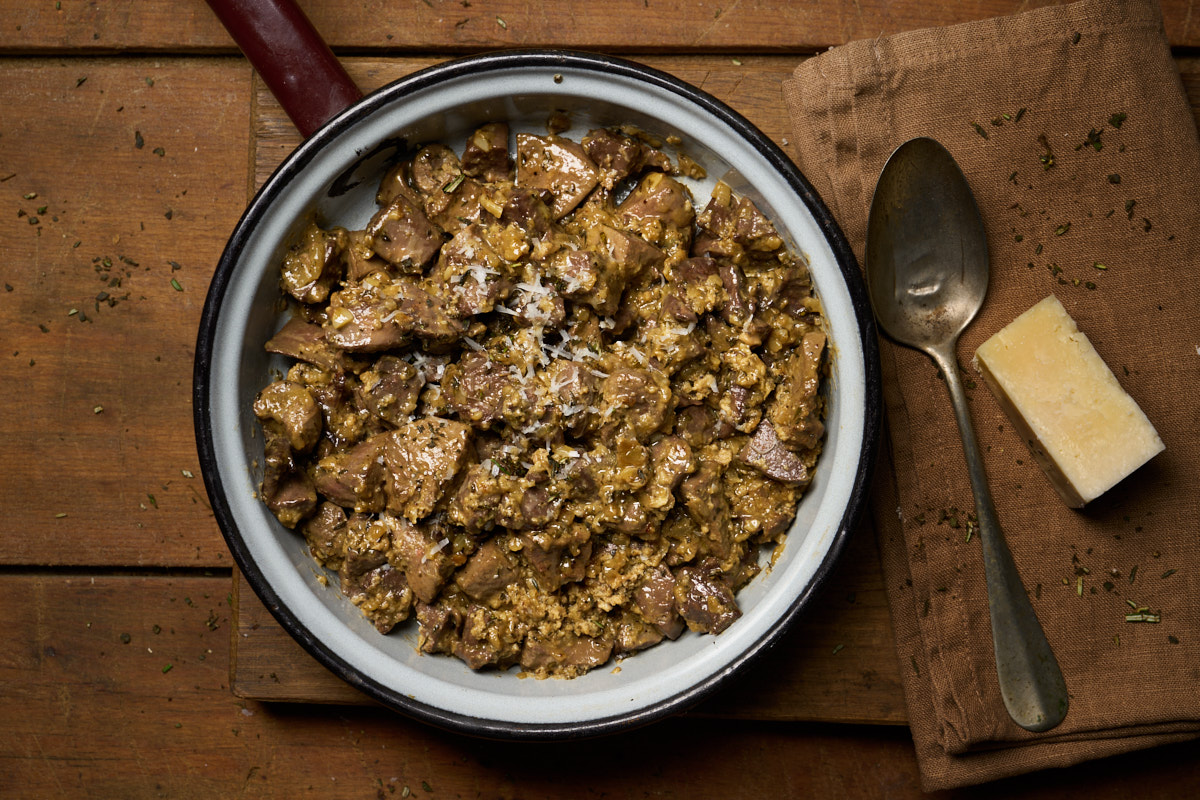
Coratella alla Marchigiana is a lamb offal dish with white wine and herbs from the Marche region of central Italy and then finished with beaten egg and grated pecorino (a hard, salty sheep’s milk cheese). The offal used is the full pluck of a young lamb – heart, lungs, liver, and kidneys. The egg and pecorino go in last, off the heat, and sets into a glossy, savoury sauce.
This dish is not for everyone, but it is a traditional part of Central Italian food tradition, and if you can look past what you’re eating, it really is quite enjoyable. In fact the keen-eyed amongst you will notice that this dish uses the same ingredients as Scottish Haggis, which thousands of people happily eat across the UK each year!
Lamb Pluck
The full lamb pluck gives you the most complete version of this dish – heart, lungs, liver, and kidneys. People call this the pluck in English because you ‘pluck’ these organs out of the lamb carcass together, all connected in one piece. And in the Pesaro-Urbino area, they often include intestines
The egg and pecorino finish is particularly typical of the Marche region. You won’t find lamb pluck in a supermarket, so you will need to find a good butcher if you want to give this a go.
Cooking Tips
There are three important steps to make this dish successful:
Adding the Liver Last: Add the liver too early and it turns grey and grainy before everything else is ready. Add it last, give it two minutes, and it stays tender. The same logic applies to the egg – the pan must be off the heat before you pour it in. The warmth left in the offal does the work. Twenty to thirty seconds of constant stirring is all it takes.
Soaking the Organs in Water and Vinegar: This is an important step before cooking because it draws out blood and takes the edge off the stronger flavours. One to two hours is enough.
Paraboiling: Parboiling the heart, lung and kidneys helps to firm up the texture and removes some of the impurities.
Coratella alla Marchigiana and Easter
Coratella alla Marchigiana is served at Easter morning in Marche, as part of a spread that includes pizza di formaggio (the region’s cheese-leavened Easter bread), ciauscolo (a soft, spreadable pork salame), hard-boiled eggs and frittata with wild mint. It is typical to eat the prime lamb cuts of the lamb for Easter Sunday lunch. But the offal doesn’t stay fresh long and the people of Marche wasted nothing, so they traditionally ate the pluck for Easter breakfast as coratella.
For the full guide to how Italian’s celebrate Easter, see the Italian Easter food guide.
Coratella Across Central Italy
Coratella is cooked across central Italy, but each region has its own preparation. The offal is broadly the same. The herbs, finishing technique and occasion differ.
Lazio cooked with Roman artichokes and marjoram. The artichokes go into the pan with the offal and cook down into the sauce. It is closely associated with Easter in Rome and the surrounding area, where lamb and artichokes come into season at the same time.
Umbria cooked with lots of onion and many households add tomato. In Norcia, white beans are added alongside the offal. It is a traditional Easter dish across the region, though it appears on family tables at other times of year too.
Marche has a consistent thread of nose-to-tail cooking that runs through the region’s most traditional dishes. From Ancona’s Trippa all’Anconetana to the famous Vincisgrassi and Ragu alla Marchigianga, offal is a consistent theme in the Marche region’s cooking.
Buon appetito! 🇮🇹
More Marche Recipes
- Vincisgrassi – Marche’s answer to lasagne – wide pasta sheets layered with meat ragu, chicken livers and bechamel.
- Potacchio Marchigiana – chicken slow-cooked with tomatoes, white wine, rosemary and garlic. A Marche classic.
- Fava Ngreccia – dried fava beans slow-cooked with wild chicory. A dish from the hills of Marche and beyond.
Coratella alla Marchigiana
Equipment
- Large bowl (for soaking offal)
- large saucepan (for parboiling)
- colander
- Chopping Board
- Sharp knife
- Wide, heavy frying pan or saute pan
- Wooden spoon or spatula
- Small bowl (for beating eggs)
- Fork or whisk
Ingredients
- 1 lamb’s pluck lamb offal (heart, lungs, liver, kidneys, approx 1kg)
- 4 eggs
- 1 small onion (finely chopped)
- 2 garlic cloves (crushed)
- 1 sprig rosemary (finely chopped)
- 4 sprigs fresh thyme (finely chopped)
- 4 sprigs fresh marjoram (finely chopped)
- 3 fresh sage leaves (finely chopped)
- 2 bay leaves
- 150 ml dry white wine
- 30 g pecorino (finely grated)
- Extra virgin olive oil
- Salt and black pepper
- White wine vinegar (for soaking)
Instructions
- Rinse all the offal thoroughly under cold running water. Put it in a large bowl, cover with cold water and add a splash of white wine vinegar and one of the bay leaves. Leave to soak for 1-2 hours. Drain, rinse again and pat dry.
- Bring a large saucepan of unsalted water to the boil. Add all the heart, lungs and kidneys and parboil for 8 minutes. Do not add the liver. Drain into a colander, rinse under cold running water and pat dry with kitchen paper.
- Cut the offal into pieces on a chopping board. Cut into 1.5 cm chunks. Keep liver separate on the board.
- Beat the eggs with the grated pecorino, a pinch of salt and black pepper in a small bowl. Set aside at room temperature.
- Heat extra virgin olive oil in a wide, heavy pan over a medium-high heat. Add the onion and a pinch of salt, and cook for 5 minutes until soft. Add the garlic, rosemary, thyme, marjoram, sage and the second bay leaf. Cook for 3-4 minute. Then add the wine and cooke until reduced by about half.
- Add the hearts, lungs, and kidneys to the pan and cook for 8-10 minutes, turning occasionally.
- Add the liver. Cook for 2 minutes only. Season with salt and pepper. Turn the heat to its lowest setting for 30 seconds, then turn it off completely and allow to cool for a few minutes..
- Pour the egg mixture over the coratella. Stir constantly with a wooden spoon for 20-30 seconds until the egg is just set and integrated into the meat. The egg sets into the pieces rather than forming a smooth coating. Pull the pan away from the heat the moment it looks set – if it dries out, it is overcooked.
- Serve immediately.