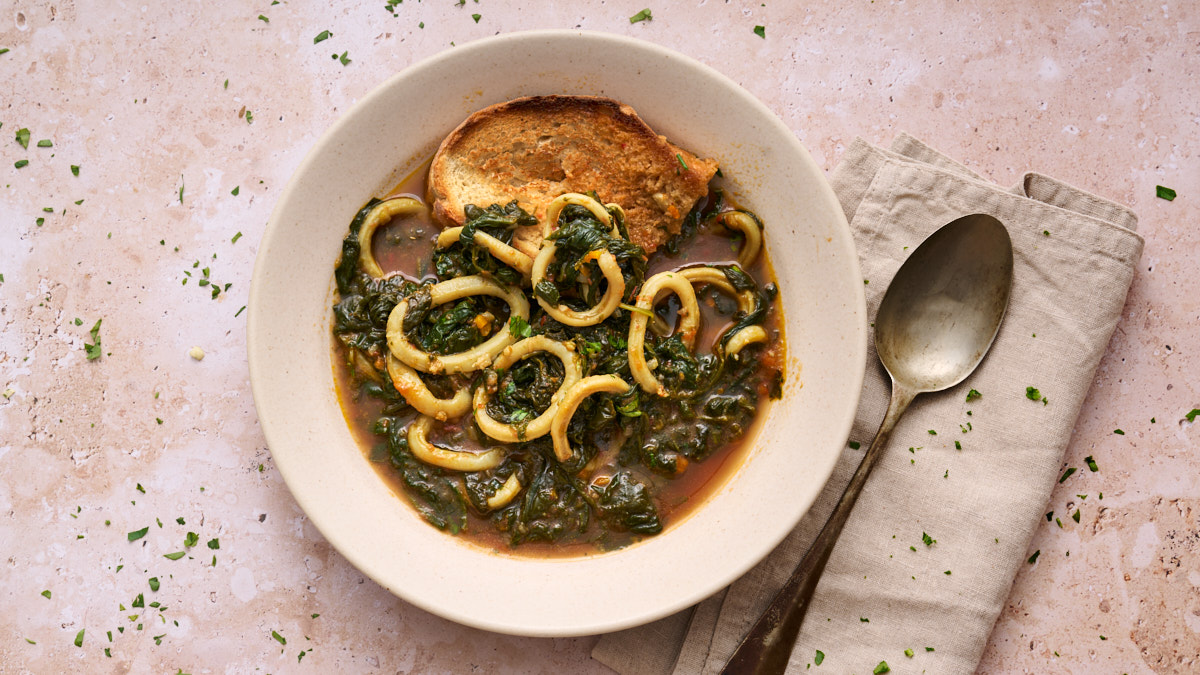
Calamari in zimino is a calamari and chard stew from the Ligurian coast. Squid rings cook slowly with chard, white wine and tomato. The base is a soffritto of onion, celery, garlic and parsley. As it cooks, the chard breaks down and the sauce thickens. You finish with maggiorana (marjoram) and serve with thick slices of toasted bread.
The first thing you notice about this dish is that it hardly has any ingredients. Other than the calamari, most of the ingredients can be foraged. Liguria has never had much agricultural land. The region is a narrow strip – mountains on one side, sea on the other. There’s little flat ground for farming, so Ligurians have always cooked with what the countryside could provide.
In fact, many Ligurian recipes, such as pansoti, use foraged greens, such as nettle, borage, chard, and dandelions as dominant ingredients which all grow well in the poor mountain soil.
What does in zimino mean?
In Italian, in zimino describes a method, not a specific dish. In Ligurian cooking, it means slow-stewing a protein with leafy greens and tomato. You find the same technique in ceci in zimino (chickpeas stewed with chard) and baccalà in zimino (salt cod prepared the same way). The term most likely derives from the Arabic samin, meaning a dense sauce.
The Tuscan Variation
Tuscany has its own version of this dish that follows the same method but uses spinach instead of chard. One reason why Tuscans use spinach may just be because it has broader valleys and more fertile land meaning Tuscan kitchen gardens could support a wider range of cultivated vegetables. Liguria, with its steep terrain and thin soils, was more dependent on what grew without much intervention – and chard grows readily in those conditions, including wild on hillsides. So the choice of green may say as much about the landscape as it does about culinary preference.
To cook the Tuscan version, replace the chard with the same weight of fresh spinach. Reduce the wilting time in step 3 to 4-5 minutes – spinach cooks faster than chard and turns soft quickly if left too long.
Buying and preparing the squid
Most fishmongers sell squid ready-cleaned. Supermarket fish counters often do too. If yours doesn’t, ask them to do it, as this doesn’t cost more and will save you save you some time. Frozen calamari tubes also work really well. Cut the body into thin rings. Keep the tentacles whole – they add texture to the finished dish.
Where to Find Chard
Known as Swiss chard, bietole is one of the most popular greens in Liguria and is what Ligurian use for this dish. Look for firm, dark leaves with no yellowing. Remove the stalks before cooking. They take much longer than the leaves to soften. If you leave them in, the texture becomes uneven. The leaves cook down a lot, so 500 grams of raw chard is the right amount for four people.
Chard is not always that easy to find. But you can use spinach as a substitute. In fact, this is what they use in this dish across the Tuscan border. The good news is that chard is really easy to grown at home. If you can find some space in your garden or in pots to sow a few seeds, you will have a very cheap supply of greens for the summer and autumn.
Buon appetito! 🇮🇹
More Food from Liguria
Liguria is a region of intense, precise flavours – built on basil, olive oil, anchovies, and the sea.
- Buridda di Seppie – Liguria’s seafood stew of cuttlefish, peas and potatoes.
- Pesto di Fave – Ligurian fava bean pesto, a spring alternative to the classic basil pesto.
- Funghi alla Genovese – sauteed mushrooms in the Genoese style with butter, olive oil, garlic and fresh oregano.
Calamari in Zimino
Equipment
- Wide heavy-based casserole or deep frying pan
- Chopping Board
- Chef’s knife
- Wooden Spoon
- colander
Ingredients
- 800 grams calamari (cleaned, cut into thin rings (tentacles kept whole))
- 600 grams Swiss chard (stalks removed, leaves roughly chopped)
- 250 grams tinned peeled tomatoes (crushed by hand)
- 1 medium white onion (finely chopped)
- 1 stick celery (finely chopped)
- 1 clove garlic (finely chopped)
- 2 tbsp flat-leaf parsley (finely chopped)
- 4 sprigs fresh marjoram (leaves picked)
- 100 ml dry white wine
- 4 tbsp extra virgin olive oil
- 1 tsp dried chilli flakes
- Salt
- Black pepper
Instructions
- Heat the olive oil in a wide, heavy-based pan over a low-medium heat. Add the onion, celery and a pinch of salt. Cook gently for 8-10 minutes until soft. Do not colour.
- Add the garlic, parsley and chilli flakes. Cook for 2 minutes, stirring.
- Add the chard. Stir to combine, cover and cook over a low heat for 8-10 minutes until wilted.
- Raise the heat to medium-high. Add the squid and cook for 3-4 minutes, stirring, until opaque.
- Pour in the white wine. Let it bubble and reduce for 2-3 minutes until the alcohol has cooked off.
- Add the crushed tinned tomatoes. Stir well, season with salt and pepper, reduce the heat to low, cover and cook for 20 minutes.
- Remove the lid. If the sauce is too wet, raise the heat and cook uncovered for a further 3-4 minutes to reduce.
- Scatter over the marjoram leaves. Taste, adjust seasoning and serve immediately with toasted bread.
Notes
- Calamari releases liquid as it cooks – don’t be alarmed if the pan looks wet after step 6. The uncovered reduction in step 7 handles this.
- Marjoram is added at the end – it loses its flavour if cooked for too long.
- Taggiasca extra virgin olive oil is worth using here if you can find it.