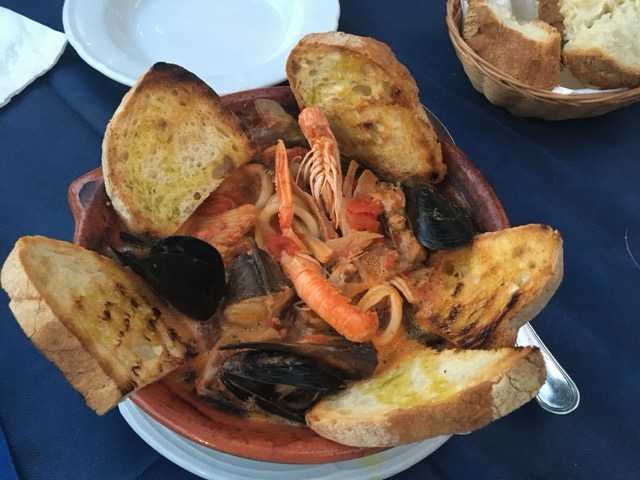
Ciambotto is the fish stew of Puglia’s Gargano coast — the one that’s been on the tables of Vieste, Manfredonia, and Peschici for as long as the fishing boats have gone out. Twenty-two kilometres offshore, the same dish turns up on almost every restaurant menu across the Tremiti Islands. The principle is the same wherever you find it: fish and shellfish cooked in olive oil, garlic, tomato, and chilli, served over grilled bread in the bowl.
The traditional ciambotto uses pesce da zuppa (small, inexpensive fish that couldn’t be sold at market) — scorpionfish, gurnard, grey mullet, small sea bream. The recipe here uses whole sea bass or sea bream cut into steaks, plus mussels, scampi, and calamari. That’s a home-cook adaptation using fish you can actually find at a fishmonger outside Puglia. The technique stays faithful: fish in bone-in steaks, no stock added, broth built from the shellfish and the fish themselves.
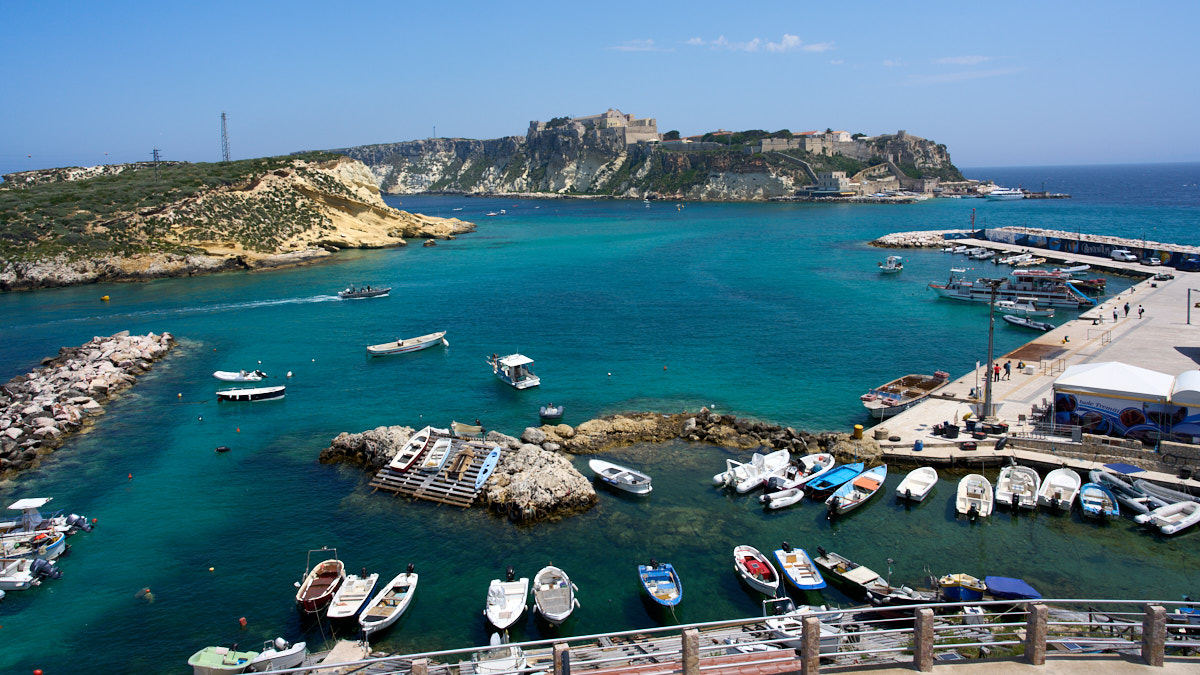
The fish go in whole, cut into thick steaks through the bone. The bone is not a problem to work around — it adds to the broth. Denser fish go in first; delicate fish follow later. You don’t stir once the fish is in the pan. You move the pan. The bread isn’t a side dish here. It goes in the base of the bowl and soaks up the broth as you eat.
Ciambotto Or Ciambotta – an important difference
Ciambotto (masculine) is the Gargano fish stew on this page. Ciambotta (feminine, with an ‘a’) is a completely different dish — a summer vegetable stew found across southern Italy, made with aubergine, courgette, peppers, and tomato. Same sound, different letter, different dish entirely. If you search for ciambotto recipes and find a vegetable stew, you’ve searched for the wrong dish.
The Right Fish For This At Home
The best substitute for Adriatic rock fish is a whole sea bass or sea bream, cut into 3-4cm steaks through the bone by your fishmonger. Red mullet works well too, if you can find it whole. Ask for the cuts skin-on — the skin holds the fish together as it cooks.
If fillets are easier to source, use thick skin-on fillets of sea bass or red mullet. Add them later than you would bone-in steaks — 4 to 5 minutes is enough — and don’t move them around. The broth will be slightly thinner without the bone, but the dish works well. Monkfish tail cut into chunks is a workable option, but it has no bone, cooks differently, and won’t give you the same presentation.
How To Eat It
Ciambotto is not a knife-and-fork dish. Use a spoon for the broth, a fork to break the flesh from the bone, and your hands when the fork stops working. On the Gargano and the Tremiti, picking up a piece of fish and pulling the flesh off with your fingers is normal. The bread in the base of the bowl is also a hands job — tear it, use it to scoop, let it absorb the broth. That’s not informal eating. That’s the point of the dish.
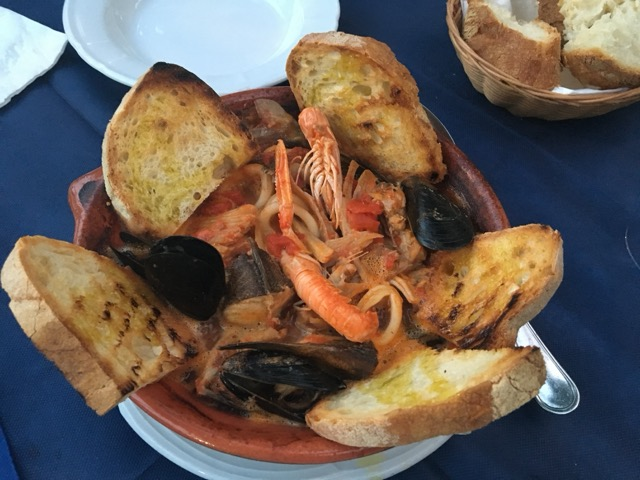
Ciambotto – Fish Stew
Equipment
- Wide, deep pan or cast iron casserole
- Fine sieve
- Sharp knife
Ingredients
- 700 grams whole sea bass or sea bream (cut into 3-4cm steaks through the bone, skin on (ask your fishmonger))
- 500 g mussels (scrubbed and debearded)
- 300 g scampi or langoustines (whole and shell-on)
- 300 g calamari (cleaned and cut into rings)
- 4 tbsp extra virgin olive oil
- 3 garlic cloves (finely sliced)
- 1 small glass white wine
- 200 grams cherry tomatoes (halved)
- 1 small onion (finely sliced)
- 1 small fresh chilli (finely sliced)
- Small bunch of flat-leaf parsley (roughly chopped)
- Salt to taste
- 4-6 thick slices of country bread (toasted or grilled until well coloured)
Instructions
- Put the mussels in a dry pan over high heat, cover, and cook 2-3 minutes until open. Remove and set aside. Discard any that stay closed. Strain the cooking liquid through a fine sieve and keep it.
- Warm the olive oil in a wide, deep pan over medium heat. Add the onion and cook 5 minutes until soft and translucent. after the garlic and chilli soften, deglaze with the white wine and let it reduce by half off before adding the tomatoes and about 200 ml of water.
- Add tomatoes and mussel liquid. Add the crushed tomatoes and the strained mussel liquid. Season lightly — the shellfish will add salt as they cook. Bring to a simmer and cook 10 minutes until the tomatoes break down into a loose broth.
- Add the calamari rings and cook 5 minutes.
- Place the fish steaks into the broth. Cook 6-8 minutes without stirring. Move the pan gently if you need to shift things around.
- Lay the scampi over the fish and cook 3 minutes until they turn orange.
- Add the mussels back in and cook 1 minute to warm through.
- To serve, scatter over the parsley. Taste and adjust salt. Place the grilled bread in the base of each bowl and ladle the stew over it, or arrange the bread around the rim.
Notes
Do not add stock. The broth builds from the fish and shellfish themselves.
Do not stir once the fish goes in — move the pan instead.
The traditional Gargano ciambotto uses small, inexpensive fish that couldn’t be sold at market — scorpionfish, gurnard, grey mullet. This recipe uses sea bass or sea bream and premium shellfish, which are what’s available outside Puglia. The technique is the same; the fish are different.
Fillet variation: use thick skin-on fillets of sea bass or red mullet. Add at step 5 but reduce cooking time to 4-5 minutes and handle carefully — fillets break more easily than steaks.